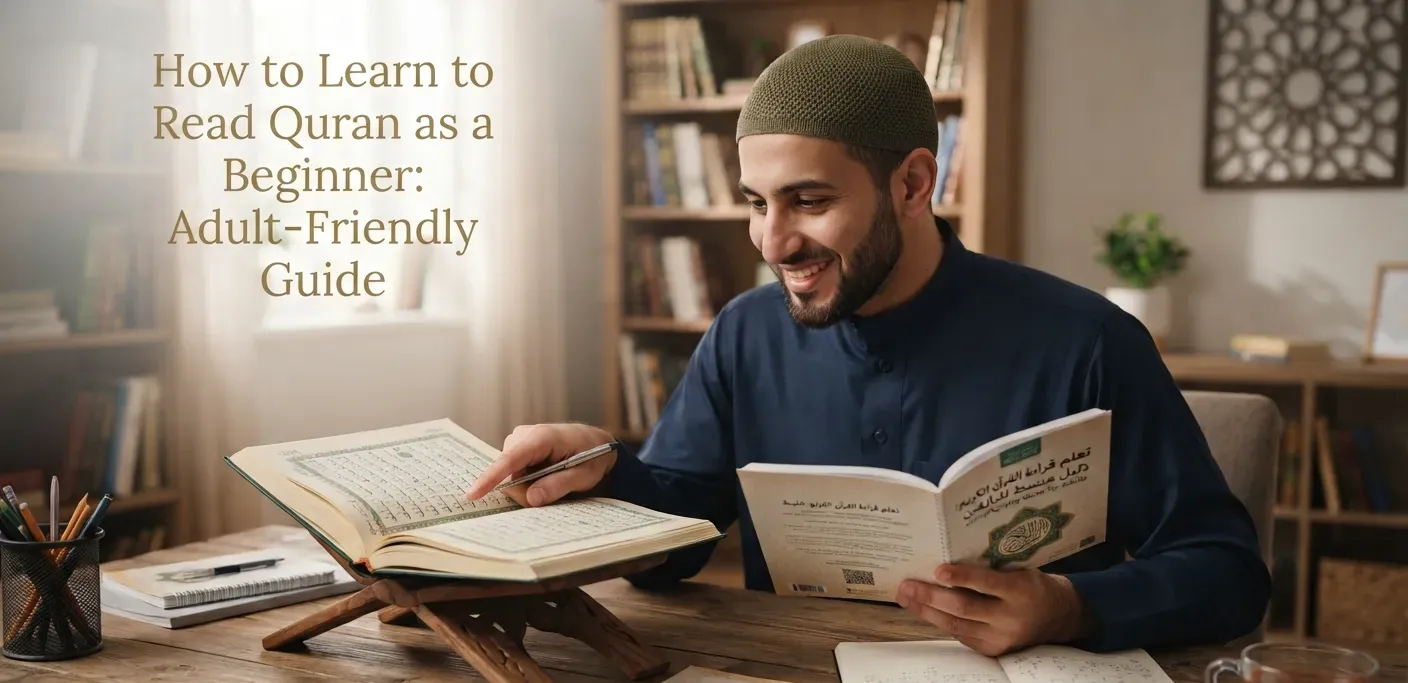
Have you ever wondered how skilled reciters make every word of the Quran sound clear, beautiful, and precise? The answer is Tajweed. For beginners, learning Tajweed can seem difficult because of complex terms and detailed rules. But it doesn’t have to be. This guide explains the simplified rules of Tajweed clearly and practically, helping English-speaking learners understand the basics, improve their Quran recitation, and build confidence step by step.
Before we dive into the rules, let us understand what Tajweed actually means.
The word "Tajweed" comes from an Arabic root word that means "to improve" or "to make something better." When we talk about reading the Quran, Tajweed means giving every single letter its right. You do this by pronouncing it from the correct part of your mouth and applying the right rules to it.
Why is this so important?
Arabic is a highly sensitive and precise language. If you change a sound slightly, you can completely change the meaning of a word.
Important Note: A common example is the Arabic word for heart, which is Qalb (قلب). If you mispronounce the first letter and say Kalb (كلب), the word suddenly means "dog." This simple mistake changes a beautiful verse into something completely different.
Learning Tajweed helps you avoid these mistakes. It protects the original meaning of the Quran exactly as Allah revealed it to Prophet Muhammad (peace be upon him).
When you study and apply these rules, you unlock several amazing benefits:
You preserve the true meaning: You ensure you do not accidentally change the words of Allah.
You earn massive rewards: The Prophet (peace be upon him) said that a person who reads the Quran beautifully and smoothly will be in the company of the noble angels.
You build confidence: You no longer feel anxious when you open the Quran. You know exactly how to sound out the words.
You connect deeply: Reading with Tajweed forces you to slow down. This slow pace helps you reflect on the words and build a deeper spiritual connection.
The very first step in our simplified rules of Tajweed is learning where sounds come from. In Arabic, we call this Makharij. This simply means the "exit point" of a letter.
If you do not know where a letter comes from, you cannot pronounce it correctly. English speakers often struggle with certain Arabic letters because these sounds do not exist in the English language.
Let us break the mouth down into three main areas.
Some Arabic letters come from deep inside your throat. You must engage your throat muscles to make these sounds.
Bottom of the throat: Hamzah (ء) and Haa (هـ). These sound like a sharp breath out.
Middle of the throat: Ayn (ع) and Haa (ح). You make these by tightening the middle of your throat. They sound raspy and sharp.
Top of the throat: Ghayn (غ) and Khaa (خ). Think of the sound you make when you gargle water.
Your tongue does most of the heavy lifting in Arabic. Letters like Saad (ص), Daad (ض), and Taa (ط) require you to press different parts of your tongue against the roof of your mouth or your teeth.
Heavy tongue letters: You need to fill your mouth with air and lift the back of your tongue to make them sound thick and heavy.
These are the easiest for beginners. You use your lips to pronounce letters like Baa (ب), Meem (م), Waw (و), and Faa (ف). You simply press your lips together or round them to create the sound.
Pro Tip: Grab a mirror! When you practice making these sounds, watch your mouth. Compare your mouth shape to videos of expert reciters.
Now we reach the most famous part of Tajweed. You will find these rules on almost every single page of the Quran.
What is a Noon Sakinah? It is simply the letter Noon (ن) with no vowel on it. It has a resting sound, like the "n" in the English word "under."
What is Tanween? It is the double vowel at the end of a word that makes an "nnn" sound (like "an," "in," or "un").
Because Noon Sakinah and Tanween make the exact same "n" sound, they share the exact same four rules. The rule you use depends entirely on the letter that comes immediately after the "n" sound.
Izhaar means "to make clear." You use this rule when a throat letter (ء, هـ, ع, ح, غ, خ) comes right after the "n" sound.
The Action: You pronounce the "n" sound clearly and quickly. You do not stretch it. You do not hide it. Just say it normally and move on.
Idghaam means "to merge" or "to blend." You use this rule when the "n" sound meets one of these six letters: Yaa (ي), Raa (ر), Meem (م), Laam (ل), Waw (و), or Noon (ن).
The Action: You completely drop the "n" sound and jump straight into the next letter. You blend them together.
Example: If the word says "Min Maa," you read it as "Mim-maa." You skip the "n" completely.
Iqlab means "to change." This rule only happens with one letter: Baa (ب).
The Action: When the "n" sound meets a Baa, you change the "n" into a Meem (m) sound. You will usually see a tiny little Meem (م) written above the word in the Quran to remind you.
Example: The word "Min Ba'di" becomes "Mim Ba'di."
Ikhfaa means "to hide." You use this rule for all the remaining letters of the Arabic alphabet.
The Action: You do not say a clear "n," but you do not completely skip it either. You hover your tongue right behind your teeth, getting ready to say the next letter, and you let a light humming sound come through your nose.
Just like Noon, the letter Meem (m) has special rules when it has no vowel (Meem Sakinah). These rules are very easy to remember because there are only three of them.
This rule happens when a Meem Sakinah meets the letter Baa (ب).
The Action: You lightly close your lips and hold the sound in your nose for two seconds. You do not press your lips too hard. Keep it gentle.
This rule happens when a Meem Sakinah meets another Meem (م).
The Action: You merge the two Meems together into one strong Meem. You hold your lips together and make a humming sound through your nose for two seconds.
This rule applies to every other letter in the alphabet.
The Action: You say the Meem clearly, part your lips immediately, and move to the next letter. Do not hold it, and do not hum.
You have probably noticed reciters making a beautiful, vibrating humming sound during certain parts of their recitation. This sound is called Ghunnah.
Ghunnah is a nasal sound. It comes entirely from your nasal passage, not your throat or mouth.
Test It Out: Try saying a long "Mmm" sound. Now, pinch your nose completely closed. The sound should stop immediately. If the sound continues, you are using your throat, not your nose!
You must apply a strong Ghunnah whenever you see the letters Noon (ن) or Meem (م) with a Shaddah on top. A Shaddah looks like a tiny letter "w".
The Action: When you see a Noon or Meem with a Shaddah, you must hold the sound in your nose for exactly two beats. Do not rush past it. Take your time, hold the hum, and let the beautiful sound fill the room.
Arabic has a fascinating rule called Qalqalah. In English, we might call this an "echo" or a "bouncing sound."
Sometimes, when you stop on certain letters, the sound gets trapped in your mouth. To release the sound, you have to create a tiny extra bounce or echo at the end of the letter.
There are only five Qalqalah letters. You can remember them easily by memorizing this short phrase: Qutb Jad (قُطْب جَد). The letters are:
Qaaf (ق)
Taa (ط)
Baa (ب)
Jeem (ج)
Daal (د)
You only apply the echo when one of these five letters has a Sukoon (a resting state with no vowel) on it. You also apply it if you decide to stop your breath on a word that ends with one of these letters.
The Action: Do not add a full vowel. Just let the letter pop off your tongue. Think of a tennis ball hitting a wall and bouncing right back.
Madd means to stretch or elongate the sound of a vowel. This is what gives the Quran its flowing, rhythmic melody.
There are three letters of Madd in Arabic. They are Alif (ا), Waw (و), and Yaa (ي). When these letters have no vowel on them, they act like stretching machines for the letter that comes before them.
This is the default stretch. Whenever you see an Alif, Waw, or Yaa acting as a vowel, you stretch the sound for two beats.
Example: In the word "Nooh," you hold the "oo" sound for two seconds. You do not chop it short.
Sometimes, you need to stretch the sound for four, five, or even six beats! How do you know when to do this?
The Quran makes it easy for you. You will see a squiggly line (like a wave ~) drawn above the letter. This wave symbol tells you to stretch the sound longer than normal.
When does this happen? Usually, this happens when a Madd letter is followed closely by a Hamzah (ء) or a Shaddah.
The Action: Take a deep breath, relax your voice, and hold the vowel sound steady for up to four or six beats.
Explore Our Online Tajweed Course
In English, the letter "R" and the letter "L" always sound the same. But in Arabic, the letter Raa (ر) and the Laam (ل) in the word "Allah" can change their personality. Sometimes they are heavy, and sometimes they are light.
Heavy Raa: If the Raa has a Fatha (an "a" vowel) or a Dammah (an "u" vowel) on top of it, you make the sound heavy. You fill your mouth with air and lift your tongue.
Light Raa: If the Raa has a Kasrah (an "i" vowel) under it, you make the sound light. You keep your tongue flat and smile slightly when you say it.
The name of God is treated with special respect in Tajweed.
Heavy Sound: If the letter right before the word "Allah" has a Fatha ("a") or Dammah ("u"), you pronounce "Allah" with a deep, heavy sound (like "Aw-law").
Light Sound: If the letter right before "Allah" has a Kasrah ("i"), you pronounce the word "Allah" lightly (like "Al-lah"), keeping your mouth flat.
Reading the Quran requires breath control. You cannot read an entire page in one breath! Knowing exactly where and how to stop is a crucial part of the simplified rules of Tajweed.
When you read a normal book, you look for commas and periods. The Quran has its own unique set of traffic lights. These tiny symbols sit above the words to guide you.
The small Meem (م): This is a mandatory stop. You must stop reading and take a breath. If you continue, you might accidentally change the meaning of the sentence.
The small Laa (لا): This means "Do not stop!" You must push forward and connect the word to the next one.
The small Jeem (ج): This is a neutral stopping point. You have the choice to stop and breathe, or you can keep going. Both are perfectly fine.
Three dots (∴): You will see these dots come in pairs. They mean you can stop at the first set of dots OR the second set, but you cannot stop at both.
Crucial Rule: Whenever you decide to stop on a word, you must strip away the final short vowel of that word. You turn the last letter into a resting state (Sukoon). You never stop on a bouncing, active vowel sound.
When you first start learning, you will naturally make mistakes. This is part of the beautiful learning process. However, knowing the most common pitfalls can help you progress much faster.
Many beginners want to read fast because they see expert reciters doing it. This is a big mistake. When you rush, you chop your vowels short, skip the Ghunnah (humming), and miss the Qalqalah (echoes).
The Fix: Read painfully slow. Treat every single word as its own separate project. Speed comes naturally over time.
It is very easy to confuse a regular "T" (ت) with the heavy "T" (ط), or a regular "S" (س) with the heavy "S" (ص).
The Fix: Exaggerate your mouth movements when practicing. When making heavy sounds, push your lips out and fill your cheeks with air.
Sometimes beginners get nervous and stretch a normal short vowel into a long Madd vowel. Saying "Baaa" instead of a quick "Ba" can accidentally change the meaning of a word.
The Fix: Keep a steady, marching rhythm. Short vowels get one quick beat. Long vowels get two full beats.
Learning the theory behind the simplified rules of Tajweed is only the first half of the journey. The second half is building muscle memory. Here is how you can train your tongue at home.
Your ears need to learn Tajweed before your tongue can. Find a reciter who reads slowly and clearly. Sheikh Mahmoud Khalil Al-Husary is famous for his perfect, unhurried Tajweed. Listen to him while following along in your Quran. Pay attention to how long he holds his nasal sounds and how he bounces his echo letters.
We often think we sound great in our own heads. But our ears can deceive us. Open your phone's voice memo app and record yourself reading a short chapter, like Surah Al-Ikhlas. Play it back and compare it to a professional reciter. You will instantly hear where you need to improve.
Tajweed is a physical exercise. You are training muscles in your throat, tongue, and lips that you have never used before. Watch your mouth in the mirror. Are your lips rounding on the letter Waw? Is your tongue lifting on the heavy letters? Visual feedback is a game-changer.
The Prophet Muhammad (peace be upon him) said: "The one who is proficient in the recitation of the Quran will be with the honourable and obedient scribes (angels), and he who recites the Quran and finds it difficult to recite, doing his best to recite it in the best way possible, will have two rewards."
Let that comfort you. Your struggle is heavily rewarded. Take it one letter, one rule, and one day at a time.
Reading articles and watching videos will give you an excellent foundation. You now understand the simplified rules of Tajweed. You know about hiding the Noon, stretching the vowels, and echoing the Qalqalah.
However, there is one thing an article cannot do for you: An article cannot listen to you and correct your mistakes.
Tajweed is an oral tradition. For over 1,400 years, it has been passed down directly from teacher to student. To truly master the beautiful recitation of the Quran, you need an expert ear to guide you. You need a friendly, patient teacher who can say, "Stretch that sound a little longer," or "Lift your tongue a bit higher."
This is exactly why we created our Online Tajweed Course.
We built our program specifically for beginners and English speakers. We understand your struggles. We match you with certified, patient instructors who make learning easy, interactive, and incredibly rewarding.
What you will get in our course:
One-on-one personalized feedback: Learn at your own pace without any pressure.
Flexible scheduling: Take classes from the comfort of your home at a time that works for your busy life.
Step-by-step curriculum: We build on the simplified rules of Tajweed you learned today and turn them into natural habits.
A supportive environment: We celebrate your progress and support you through the difficult letters.
You have already taken the beautiful first step by researching how to improve your Quran reading. Do not let your journey stop here.
Click Here to Explore Our Online Tajweed Course and Start Your First Lesson Today!
Learning to read the Quran with proper Tajweed is one of the most fulfilling journeys you will ever take. Yes, the mouth movements might feel strange at first. Yes, you might forget a rule here and there. But every single attempt you make bridges a closer connection between you and the words of Allah.
By mastering these simplified rules of Tajweed, you are setting yourself up for a lifetime of confident, peaceful, and accurate recitation. Keep practicing, stay patient with yourself, and remember that every single letter you struggle with is bringing you double the reward.
Open your Quran, take a deep breath, and let the beautiful journey begin!
Do I need to be fluent in Arabic to learn Tajweed?
Not at all! You do not need to understand Arabic grammar or vocabulary to learn Tajweed. You only need to know how to recognize and read the Arabic alphabet. Our simplified rules of Tajweed focus purely on how to make the correct sounds and mouth movements.
How long does it take to master these basic rules?
It depends on how often you practice. Most beginners can understand the theory of the basic rules within a few weeks. However, training your tongue and building muscle memory to apply them naturally can take a few months of consistent practice with a qualified teacher.
Can I learn Tajweed just by watching videos and listening to reciters?
Videos and audio recordings are fantastic tools for learning the theory and training your ear. However, Tajweed is an oral tradition. You cannot hear your own mistakes accurately. To truly master the recitation, you need a live teacher who can listen to you and correct your specific errors.
Is it a sin if I make mistakes while I am learning?
No, you are not sinning! It is completely normal to make mistakes when you are a beginner. Islam highly encourages the learning process. In fact, Prophet Muhammad (peace be upon him) promised that a person who struggles and finds it difficult to read the Quran, yet keeps trying, will receive double the reward.
What is the absolute best way to practice at home between lessons?
Read extremely slowly. Do not rush. Record your own voice on your phone and compare it to expert reciters like Sheikh Mahmoud Khalil Al-Husary. Additionally, practice reading in front of a mirror so you can physically see if your lips and tongue are in the right position.