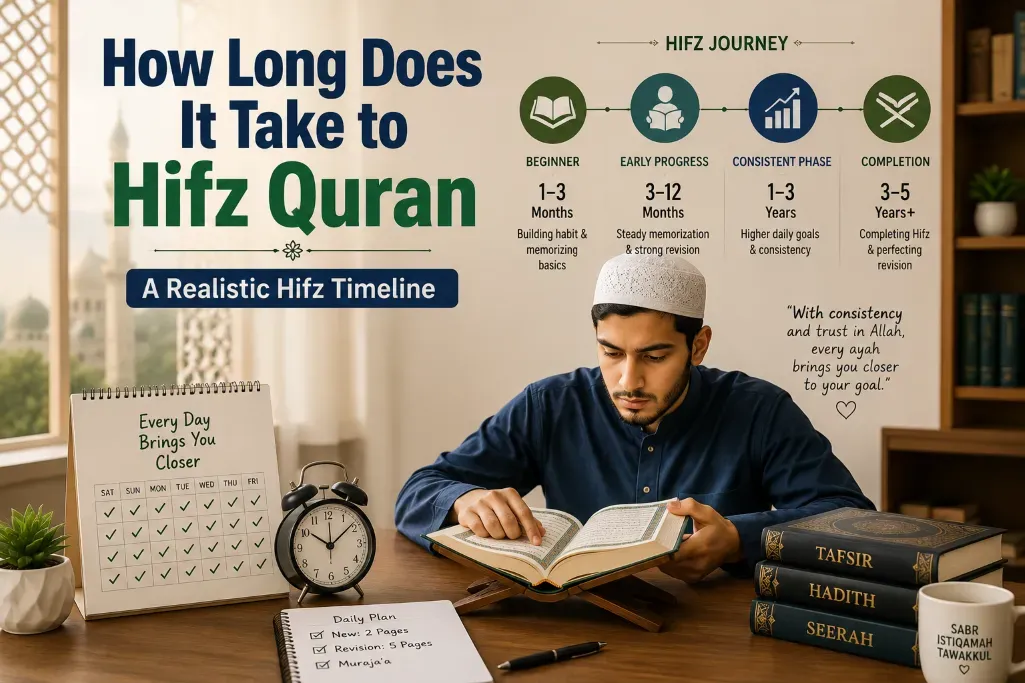
Discover how long it realistically takes to memorize the Quran, what factors affect your Hifz timeline, and how to create a consistent memorization plan that works for your pace and schedule.
Memorizing the Holy Quran is a rewarding journey, but it requires patience, consistency, and a realistic plan. If you are starting Hifz, one of the first questions you may ask is: how long does it take to hifz quran? While some people claim to memorize the Quran in a few weeks or months, these cases are rare. For most learners, building strong and lasting memorization takes time. In this guide, we’ll explore realistic Hifz timelines, the factors that affect your progress, and practical habits to help you succeed.
To give you a direct answer: it typically takes between 2 to 5 years to memorize the Quran.
This timeline depends entirely on your daily routine, your age, and your focus. The Quran contains 114 Surahs (chapters), 30 Ajza (parts), and approximately 604 pages in the standard Uthmani script (Madinah Mushaf).
Let us break down the simple math to help you understand how long it will take based on your daily memorization goals.
If you memorize every single day without taking any breaks, here is how the numbers look:
2 Pages a day: About 10 months
1 Page a day: About 1 year and 8 months
Half a page a day: About 3 years and 4 months
One-fourth of a page (a few lines) a day: About 6 years and 8 months
Important Note: These numbers represent raw memorization. They do not account for sick days, holidays, busy weekends, or days dedicated entirely to revision. Always add an extra 20% to 30% to your calculated timeline to keep things realistic.
Now that we know the basic math, let us look at the three most common timelines for Hifz students.
This is a very fast-paced timeline. It requires you to memorize one to two pages every single day.
Who is this for? Full-time students, young adults taking a gap year, or people attending a dedicated, full-time Hifz boarding school.
The Reality: You will need to spend 4 to 6 hours a day memorizing and revising.
The Risk: Memorizing this fast often leaves weak spots in your memory. You will need to spend a full year after finishing just to solidify what you memorized.
This is the most common and recommended timeline across the world. You memorize about half a page to one full page per day.
Who is this for? University students, teenagers, and adults who can manage their time well.
The Reality: You need to dedicate about 2 to 3 hours a day. This gives your brain enough time to absorb the verses and connect the words properly.
The Reward: Your memory will be much stronger. You have enough time to balance new memorization with daily revision.
This is the most realistic path for busy professionals, parents, and young school children. You memorize a few lines or a quarter of a page each day.
Who is this for? People working full-time jobs, mothers with young children, or anyone who wants a stress-free journey.
The Reality: You only need 45 minutes to 1 hour a day.
The Reward: It builds incredible consistency. It integrates the Quran into your daily life without overwhelming you.
You might wonder why two people can start at the same time, but one finishes two years earlier. When asking how long does it take to hifz quran, you must look at your personal circumstances. Several key factors change the speed of your journey.
You get exactly what you put in. A person who gives the Quran three hours of undivided attention daily will finish much faster than someone who studies for twenty minutes while checking their phone. Time-block your schedule. Focused time always beats scattered time.
Children have incredibly flexible brains. They soak up information like sponges. A ten-year-old might memorize a page in thirty minutes, while a forty-year-old might need two hours. However, adults have better discipline and understand the deeper meanings of the text, which helps them stay motivated.
If you speak and understand Arabic, you already have a massive advantage. You understand the grammar, the sentence structure, and the stories. If you do not speak Arabic, do not worry. Millions of non-Arabs memorize the Quran beautifully. It just takes a little more time to get used to the pronunciation and flow of the words.
Consistency is the great equalizer. Memorizing half a page every single day is much better than memorizing five pages on Sunday and doing nothing for the rest of the week. Drops of water eventually carve through solid rock. Regular, daily habits speed up your timeline significantly.
You cannot memorize the Quran alone. You need a qualified teacher (Muhaffidh). A good teacher will fix your Tajweed (pronunciation rules), point out your mistakes, and hold you accountable. Trying to memorize on your own often leads to hidden mistakes that take months to unlearn.
Understanding the timeline requires understanding the phases of Hifz. You do not just open the book and start memorizing at top speed. Your journey will happen in four distinct phases.
Do not rush to memorize large chunks right away. In the first few months, your main goal is to perfect your Tajweed. If you memorize with the wrong pronunciation, fixing it later is incredibly difficult. Spend this time building your daily habit, learning how to read fluently, and memorizing short Surahs.
Your brain is a muscle. When you first start working out, it hurts, and you get tired quickly. After a few months, your "memorization muscle" gets stronger. A page that used to take you two hours will now take you forty-five minutes. You will find your natural pace during this phase.
This is the hardest part of the journey. You are in the middle of the Quran. The initial excitement has faded, and the finish line is still far away. This is where many people quit. To survive this phase, you must rely on strict discipline rather than motivation. Stick to your daily routine, even when it feels heavy.
Many people think the journey ends when they memorize the last Surah. The truth is, the real journey begins after you finish. You will spend the next year or two actively reviewing the entire Quran until it sits firmly in your heart.
"Memorizing the Quran is like catching a runaway camel. If you do not tie it down continuously, it will escape." — (Based on a famous Hadith of Prophet Muhammad ﷺ)
Learn to memorize the Quran with us
If you want to stick to your timeline, you must structure your daily study sessions properly. Traditional Islamic scholars use a three-part system for daily Hifz. You must do all three every single day.
This is the brand-new portion you are memorizing for the day. It could be five lines, half a page, or a full page. You should memorize this when your mind is fresh, ideally right after Fajr prayer.
This is the most critical part of your daily routine. Sabaqi refers to the last 10 to 15 pages you recently memorized. Because this memory is new, it is very weak. You must recite these recent pages to your teacher every day to ensure they do not slip away.
This is the revision of everything you memorized in the past. If you have memorized five Ajza (parts), you should read at least half a Juz or one full Juz every day. This keeps your old memory sharp and strong.
While you should never rush, there are smart techniques you can use to make your memorization faster and easier.
Stick to One Mushaf: Never change the physical copy of the Quran you read from. Your brain uses visual memory to remember where words are on a page. If you switch books, you confuse your visual memory. Use the standard 15-line Madinah Mushaf.
Listen to Audio Recitations: Before you memorize a new page, listen to a famous reciter (like Sheikh Khalil Al-Husary or Sheikh Mishary Rashid) read that exact page. Listen to it five or ten times. This trains your ears and makes reading the words much easier.
Understand the Meaning: Keep a translated copy of the Quran nearby. Read the translation of the page before you memorize it. When you understand the story, your brain links the verses together logically.
Recite in Your Prayers: Use your newly memorized verses in your daily Sunnah and Nawafil prayers. Standing on your prayer mat and reciting from memory tests your confidence and locks the verses into your heart.
Find a Hifz Buddy: Pair up with a friend who is also memorizing. Compete with each other in a healthy way. Call each other to test your daily revision. Accountability works wonders.
Many students wonder how long does it take to hifz quran because they feel frustrated with their slow progress. Often, they are making one of these common mistakes.
This is the number one trap. Students want to finish quickly so they can say they are a Hafiz. They memorize two pages a day but forget everything they learned last week. Slow down. A strong half-page is better than two weak pages.
If you have limited time on a certain day, skip your new memorization. Never skip your revision. Memorizing new verses while forgetting old ones is like filling a bucket that has a giant hole in the bottom.
Memorizing in the morning on Monday, at night on Tuesday, and skipping Wednesday destroys your momentum. Your brain loves habits. Pick a specific time of day and a specific place in your house. Sit there every day.
Islamic scholars historically taught that knowledge is a light from God, and this light does not enter a heart filled with distractions. Spending hours scrolling through social media, watching useless videos, or engaging in negative habits reduces your ability to focus. Protect your eyes and your mind.
Parents often place heavy expectations on their children. If you are a parent wondering how long your child needs to finish Hifz, please keep these points in mind:
Do not force timelines: Every child is unique. Pushing a child to finish in two years might cause burnout. Let the child set the pace with their teacher.
Make it joyful, not a punishment: The Quran should be associated with love, rewards, and happiness. Celebrate small milestones. Buy them a gift when they finish a Juz.
School comes into play: If your child goes to a regular academic school, a 4 - 5 year timeline is the most realistic and healthy approach.
Important Note: A child who takes six years to memorize the Quran but loves the book is far more successful than a child who memorizes it in two years but hates the process due to extreme pressure.
There will be days when you want to quit. You will look at a page, and the words just will not stick. On those hard days, remind yourself why you started.
You are not doing this to get a certificate. You are doing this to carry the words of the Creator in your chest.
Remember the beautiful promise given to the companions of the Quran. On the Day of Judgment, it will be said to the one who memorized the Quran:
"Read, ascend, and recite slowly and distinctly as you used to recite in the world, for your station will be at the last verse you read."
Every struggle you face, every time you repeat an Ayah (verse) twenty times to get it right, God records it. The journey itself is an act of worship. Do not stress over the finish line. Enjoy the daily company of the Quran.
You can begin your journey in memorizing the Quran from here
So, how long does it take to hifz quran? As we have explored, a realistic timeframe is anywhere from two to five years. Do not view this timeline as a race against the clock. Do not compare your chapter two with someone else's chapter twenty. Your journey is unique to you. Focus on building a daily habit. Find a good teacher, perfect your Tajweed, respect the process of daily revision, and ask God for sincerity and ease. Whether it takes you two years or ten years, the time will pass anyway. You might as well spend those years filling your heart with the most beautiful words ever spoken. Start today. Pick up your Mushaf, learn one verse, and take that first beautiful step forward.
Can I memorize the Quran in 6 months?
Technically, yes, if you do nothing else but study 8 to 10 hours a day. However, it is highly discouraged for beginners. Memorizing that fast usually results in a very weak memory that fades away as soon as you stop reviewing.
Can I do Hifz online?
Absolutely. Online Hifz academies have made it easier than ever. You can connect with highly qualified teachers from Egypt, Saudi Arabia, or anywhere else via video calls. Just ensure the teacher has an Ijazah (a certified chain of transmission).
Am I too old to memorize the Quran?
No one is ever too old. People in their sixties and seventies have successfully memorized the entire Quran. It might take a little more time and repetition, but adults bring patience, wisdom, and sincerity to their studies.
What is the best time of day to memorize?
The hours immediately after Fajr (dawn) prayer are universally considered the best time. Your mind is completely fresh, the house is quiet, and the day has not yet brought its stresses.
What happens if I forget a part of what I memorized?
Do not panic. Forgetting is a natural human trait. Simply go back, treat it like a new lesson, and memorize it again. It will come back to you much faster the second time around.

Learn the best way to learn Quran online with a practical step-by-step guide.
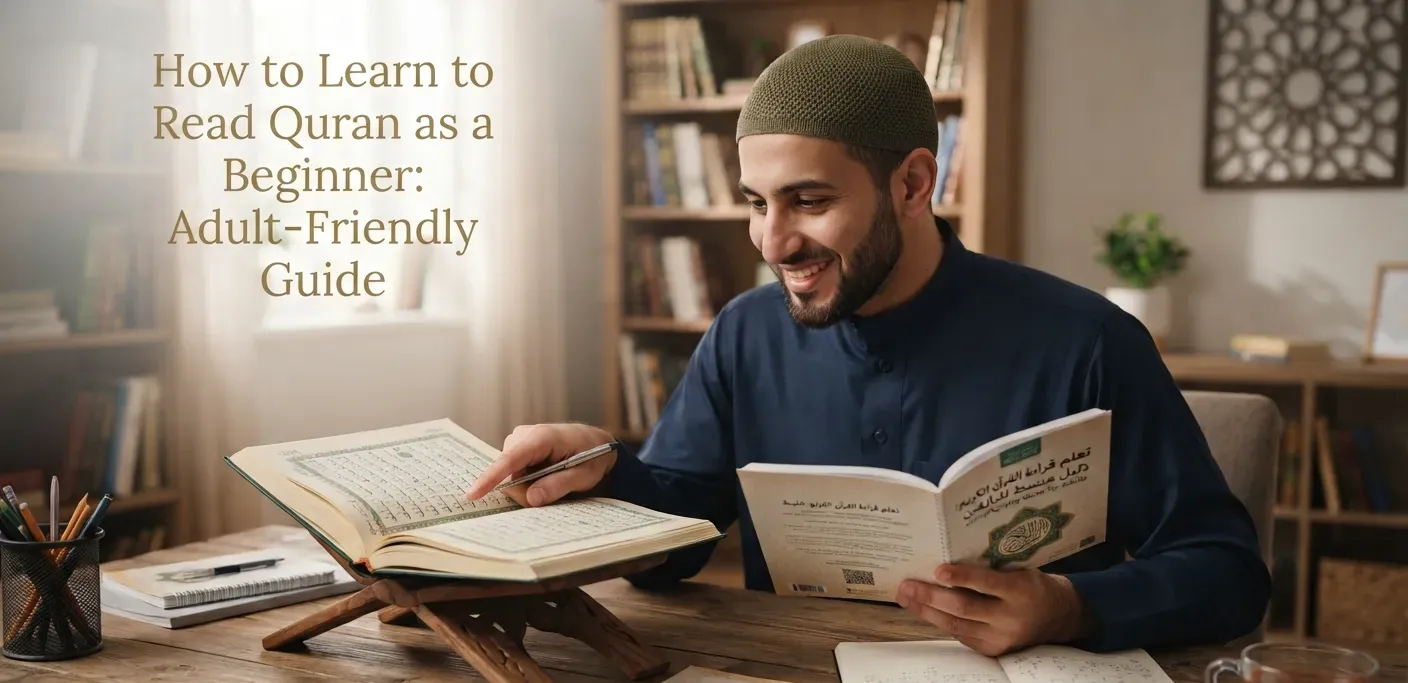
Never learned Quran as a child? Start today with a beginner-friendly path built for adult learners — no experience needed.
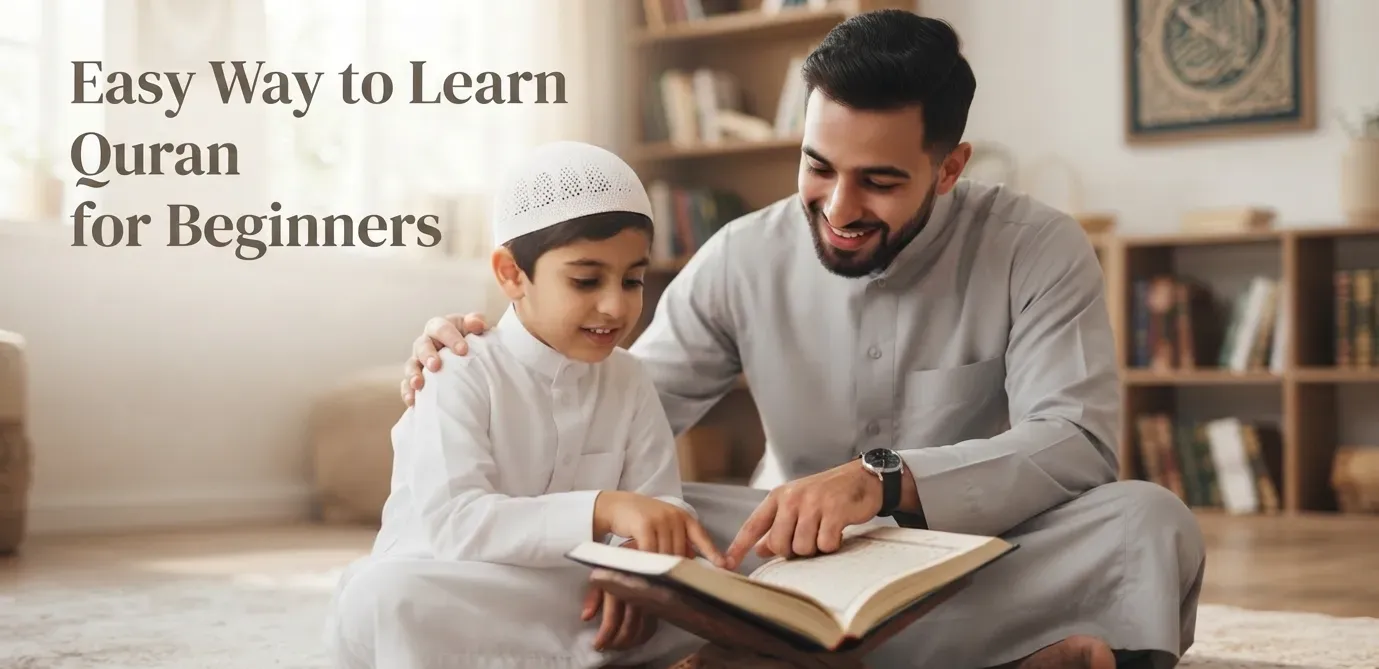
Discover an easy way to learn Quran for beginners with 4 practical steps to improve pronunciation, build strong reading skills, and start your Quran learning journey with confidence.
